



More expensive raw materials, higher freight costs
The shock we are currently experiencing is immense
Europlast, based in the Upper Drau Valley, exports plastic containers to half of Europe. Raw materials, which have become much more expensive due to the war, and higher freight costs are weighing on the business. Nevertheless, millions are being invested.
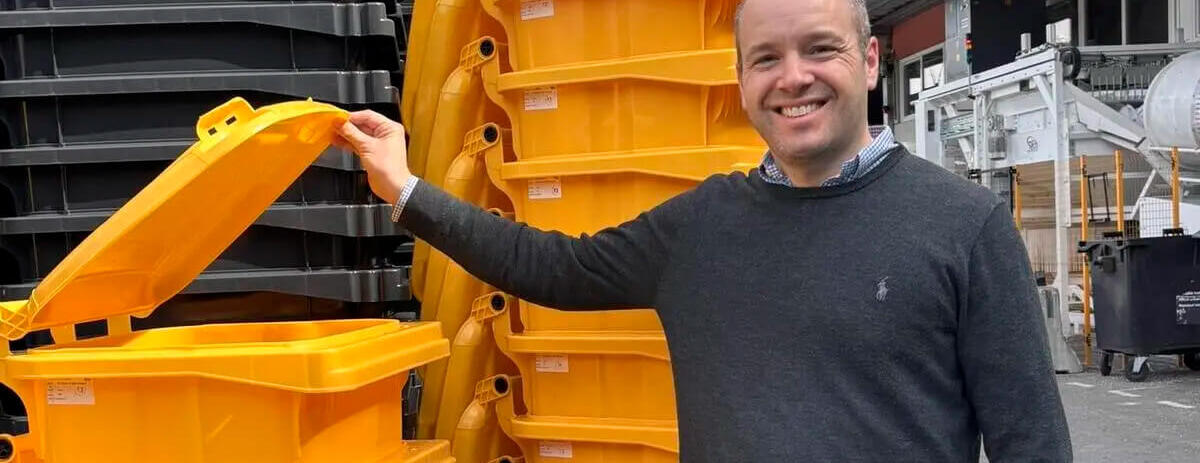
The assembly hall, which covers around 3,000 square metres and has recently been completely refurbished and extended at a cost of around 3.8 million euros, is the most striking investment project at Europlast in Dellach in the Drau Valley. It exemplifies the long-term thinking and approach of the Italian Foresti family, the owners (JCOPLASTIC Group), says Georg Schnaubelt, managing director of Europlast. A native of Weißbriach who has returned to Carinthia, he worked in Germany for many years and has been at the helm of the company since early 2024.
Europlast specialises in the production of recycling bins – the term ‘rubbish bin’ is misleading, as Schnaubelt emphasises, because the current energy crisis in particular highlights the importance of having one’s own raw materials and recyclables. The bins, which are sometimes colourful, account for 60 per cent of Europlast’s turnover – which stood at 51.5 million euros in 2024. This is followed by plastic boxes for industry (20 per cent) and agriculture (10 per cent), as well as the “interesting niche of contract manufacturing using our large injection moulding machine”, according to Schnaubelt (10 per cent). The company’s site covers five hectares.
The best year in the company’s history, 2024, was followed by a somewhat weaker 2025 and a challenging 2026. However, Schnaubelt emphasises that the company is in a good position: “Others would be happy to be in our position.” He is responding to the weakening demand by not replacing staff who leave (currently 140, down from a peak of 158) and by slightly scaling back capacity.
The main problem, he says, is the price shock caused by a massive rise in raw material prices. Around 60 per cent of the raw material used at Europlast is polyethylene derived from crude oil and gas, whilst around 40 per cent comes from recycled plastic. Purchase prices for the granulate have risen by 55 to 60 per cent in the wake of the war in Iran. “These are very dramatic developments,” said Schnaubelt. Rising freight costs are also placing an additional strain on the company from the Upper Drau Valley, which supplies half of Europe – the region stretching from eastern France to Norway and south-eastern Europe: “The shock we are currently experiencing is enormous.”
Schnaubelt is also grappling with the consequences of this in his new role as spokesperson for the Upper Carinthia Regional Forum. In this capacity, he is the voice of business leaders from the Upper Carinthia region. Top of the agenda is the issue of mobility and the further expansion of the Drautal B100 federal road. “It is crucial for our businesses that we are well connected to conurbations.” Attracting qualified staff and managers to businesses in Upper Carinthia is a challenge. Combating rural depopulation is a top priority: industry in Upper Carinthia forms the basis for higher wage levels, fulfilling work and, consequently, the region’s prosperity.

